
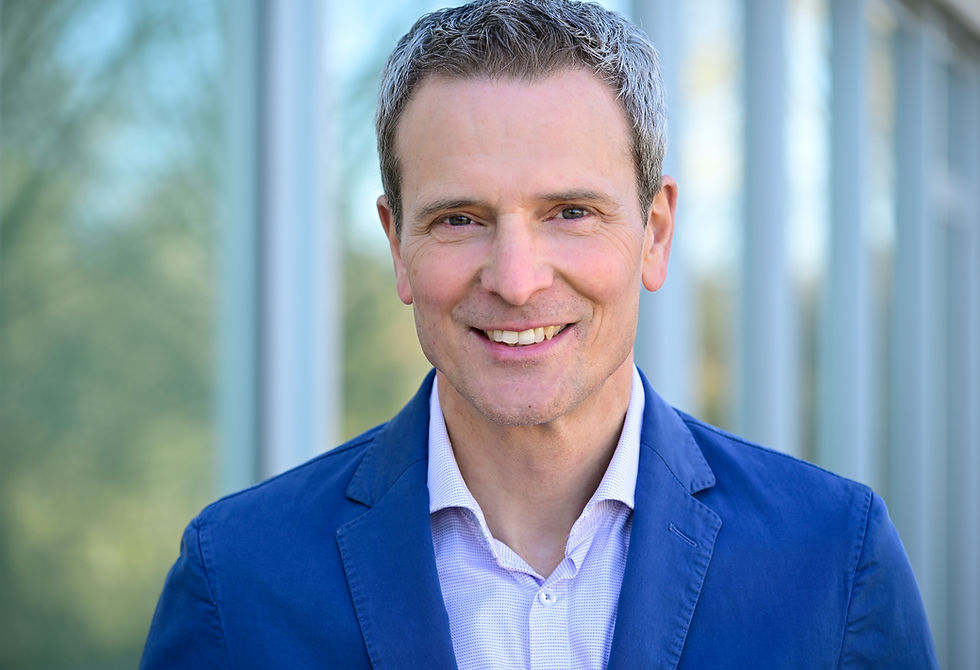
Manuel Rodríguez - GLÜCK

When GLÜCK entered the German fruit spread market in 2017, the category was already highly saturated. Shelves were filled with established brands, consumption habits were mature, and most products followed the same conventions: around 50% fruit, traditional labels and tall, narrow jars.
For Manuel Rodriguez, then Head of Marketing at Göbber and responsible for GLÜCK from 2019-2025, the opportunity from the team was not to fill an obvious gap in demand, but to redefine what a premium fruit spread could be. GLÜCK succeeded by building the brand holistically from the start, combining recipe quality, packaging, naming, design and communication into one coherent proposition.
Premiumising the Category in a Modern Way
Before GLÜCK launched, premium fruit spreads were mainly associated with tradition, craftsmanship or heritage. Mövenpick stood for indulgence, while brands such as Darbo and Bonne Maman leaned on more traditional or homemade associations. What was missing was a premium proposition that also felt contemporary. “We saw that there was still a gap at the premium end of the market,” Manuel explains. “But it also had to be modern.”
Organic brands had not fully filled that space either. While they offered naturalness and quality, many remained confined to specialist channels. GLÜCK made a deliberate choice: it would use natural product quality as its foundation, but express it through a modern, visually attractive brand rather than a rustic or niche identity.
That combination became one of the main reasons for its success. Consumers could choose something better without entering a traditional or explicitly organic world. “It looked attractive, it had a strong name, and it also tasted incredibly good,” Manuel says.
“It looked attractive, it had a strong name, and it also tasted incredibly good.”
Breaking the Rules of the Category
GLÜCK’s premium positioning started with the product. While most competitors offered around 50% fruit, GLÜCK launched with 70%. The higher fruit content created a fresher, more intense taste and allowed the brand to reduce added sugar. Artificial colours, preservatives and other additives were excluded, while carefully selected fruit and a gentle production process supported the quality promise.
This decision also created technical challenges. Less sugar meant greater demands on production, filling technology and shelf life. Significant investment was therefore required before the product even reached the shelf. “The concept was not created by someone simply thinking that GLÜCK would be a nice name,” Manuel says. “We started with the recipe, and that had to deliver first.”
The packaging was developed with the same attention. Instead of a tall, narrow jar, GLÜCK introduced a lower, wider format with a large opening. It was easier to empty, stable to handle and immediately distinctive. The branding was printed directly onto the glass rather than placed on a traditional label, giving consumers a clear view of the product and reinforcing transparency.
Even the lid was custom-made to feel heavier and more premium. None of these decisions worked in isolation. Together, they made the quality promise visible before the jar was opened. “Every brand entering a saturated FMCG category needs to bring meaningful differentiation,” Manuel explains. “Otherwise, it becomes very difficult to build sustainable success.”
“Every brand entering a saturated FMCG category needs to bring meaningful differentiation. Otherwise, it becomes very difficult to build sustainable success.”
Creating Value Beyond Breakfast
The name GLÜCK, meaning “happiness” in German, added an emotional dimension that most competitors lacked. Rather than describing ingredients or provenance, it communicated how the brand wanted people to feel. This became the basis of its mission: “GLÜCK inspires you to be happy.”
The emotional value became even stronger after the product had been consumed. Consumer research had already indicated that the jar offered strong potential for reuse. Its shape and design made it suitable for storage, flowers, decoration, DIY projects and small gifts. Consumers began sharing their own ideas and reusing the jars in ways that extended the brand far beyond the breakfast table. Empty jars were even sold online for creative projects. In many cases, people removed the product information but deliberately kept the GLÜCK name visible.
“The ingredients and other information might be removed, but the GLÜCK name remains,” Manuel says. “When people reuse or give the jar to someone else, the brand continues to be part of that moment.” This created an emotional relationship that went beyond product quality. GLÜCK was not only consumed, but reused, shared and reinterpreted by its community.
“When people reuse or give the jar to someone else, the brand continues to be part of that moment.”
From TV Awareness to Digital Participation
At launch, GLÜCK used a traditional media mix led by television. This helped build national awareness and supported fast retailer listings, particularly at EDEKA and REWE. However, TV could only tell part of the story. Short spots were effective for communicating taste and fruit content, but less suited to showing the gifting potential, DIY ideas and secondary use of the jar.
From 2019 onwards, the brand shifted progressively towards social media and influencer marketing. Food content showed different ways to enjoy the spreads, while DIY content demonstrated what could be done with the empty packaging. This proved especially powerful. Unpaid consumer videos and reels generated millions of views, showing that reuse was not a minor feature but a real engagement driver.
“We saw that the combination of indulgent food content and DIY content was highly relevant to the community,” Manuel explains. The brand’s Instagram community was regularly involved in discussions about flavours, campaigns and future ideas. Consumer reactions also helped the team decide where to focus next.
“We saw that the combination of indulgent food content and DIY content was highly relevant to the community.”
The Lesson for Premium Growth
GLÜCK is not immune to market pressure. Its price has moved above €3 per jar at a time when German consumers are increasingly cautious. Promotional purchasing has grown, while younger consumers are gradually moving away from traditional breakfasts and reducing sugar consumption.
Yet the brand’s distinctiveness supports price acceptance among part of the target audience. The arrival of competing propositions also confirms that the positioning remains attractive. “The combination of the brand execution is so appealing that others are trying to participate in it,” Manuel says.
The broader lesson is that premiumisation cannot depend on one improved feature, a new pack or a higher price. In a saturated category, the difference must be visible and consistent across the entire proposition.
For Manuel, future-proof growth starts with “clear differentiation from the current category standard that consumers can recognise at the shelf.” GLÜCK shows that a new premium brand can still succeed in a market with little apparent room for growth. But consumers need to receive more than a premium claim. The product must deliver, the packaging must make the difference tangible, and the brand must create emotional value that competitors cannot easily replicate. Since September 2025 GLÜCK is managed by the GLÜCK Manufaktur GmbH, owned by the Spanish Helios Group. The goal is to continue the sustainable growth with a strong strategic road map.
“The combination of the GLÜCK brand execution is so appealing that others are trying to participate in it.”


